Bridging the Bay: Creating a Common Collective Identity among Stakeholders of the Chesapeake Bay Watershed
Researchers






Background Info
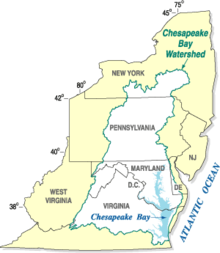
The Chesapeake Bay is the largest estuary in the U.S., with a watershed covering approximately 64,000 mi2. It stretches from Cooperstown, NY in the north, to central Pennsylvania in the west, and southern Virginia in the south. The range of ecosystems is enormous as is the range of cultures. The Bay includes densely populated areas around Washington, DC and Baltimore as well as extremely rural areas of north central Pennsylvania and upstate New York.
Problem
The Chesapeake Bay was once one of the most productive bodies of water in the world. The fishing industry thrived on rockfish, oysters, blue crab, and shad. But fertilizer, stormwater, and waste-water runoff increased the presence of nitrogen and phosphorus, which produce algae blooms and decrease water clarity. Both create conditions hostile to marine life with corresponding economic repercussions for fishing and tourism. The problem is acute: The Chesapeake Bay Foundation graded the Bay at D+ for 2018. Top-down efforts by the federal and state governments to address the problem have yielded limited success.
The poor condition of the Chesapeake Bay is the product of human behavior. For example, fertilizers used in the northern portions of the watershed to increase crop yields create costs in the form of polluted waters and depleted fisheries that are borne by downstream residents. Northern farmers may not be aware of the consequences of their actions. Or they may not care much about others who are physically and culturally distant from them, as well as being citizens of different states.
Goals
The notion of collective identity holds that individuals are able to conceive of themselves as part of a broader community defined by shared needs, values, and practices. Collective identity is not a binary, but rather a continuum that ranges from awareness that a group exists, to identifying one’s self as a group member, to the belief that collective action is required to address the obstacles that face the group. Crucial components of the construction of collective identity include shared narratives, networks of relationships, and emotional investments of group members.
The overarching aim of our project is to devise and test methods for moving residents of the watershed from awareness (or the lack thereof) towards the action end of the continuum. This involves two fundamentally communicative strategies: (a) increasing awareness of the social category (i.e., the watershed as a group unit) and (b) encouraging residents of the watershed to see themselves as members of that group.
Progress/Funding/Findings
Mainzer, S. (2023). Whose water quality? Establishing a baseline of collective identity and experimental messaging in the Chesapeake Bay Watershed. Funder: Social Science Research Institute Faculty Fellowship, Penn State. Total awarded: two course releases and $1,000 summer stipend, in total approximately $19,400.
Mainzer, S. (Core Faculty), (2024). FY24 104B State Water Resources Research Institute Program,” U.S. Geological Survey, Federal Agencies. Total awarded: $146,894.00. 15% credit. Mainzer, S., Dillard, J., Cole, C. A. A collective identity approach to addressing water quality in the Chesapeake Watershed regions of Pennsylvania,” Sub-amount awarded: $25,000
Cui, Z., Dillard, J. P., Pinto, J., High, A., De La Cruz, J. J., Mainzer, S., & Cole, C. A. (2022). Media contributions to a Chesapeake Bay Watershed Collective Identity? A tale of three cities. Environmental Management, 70, 855-868.
Abstract: Although collective action is needed to address many environmental challenges, it cannot proceed in the absence of collective identity, that is, evidence of group belongingness expressed in or via communicative behavior. This study looked for evidence of a collective identity in newspaper articles that referenced the Chesapeake Bay Watershed. The data were drawn from local papers published in municipalities located at the headwaters of the Susquehanna River, midway down the Susquehanna, and where the river meets the Bay. Computerized content analysis assessed the frequency with which the
Chesapeake Bay and watershed were mentioned alongside a set of keywords thought to represent different facets of identity (e.g., agriculture, fishing, swimming). The results showed substantial variation in frequency across time and place but low absolute levels of coverage of the Bay and the watershed. Multidimensional scaling revealed different structures to collective identity as a function of place. These differences in content may be attributable to varying demographic and environmental characteristics along with proximity to the Bay. But, to the extent that media contribute to collective identity among residents of the watershed at all, they do so in a complex and heterogeneous manner.
Mainzer, S., & Pakhtigian, E. L. (2024). Blue and red tides in the Chesapeake Bay watershed: Examining political and environmental framings of collective action during the 2016 and 2020 elections. PLOS One, 19(6), e0298962.
Abstract. Our study uses county- and individual-level descriptive analysis to examine interrelated framings of environmental quality, environmental sentiment, and political action at two critical moments in time—the 2016 and 2020 presidential elections. We find that demographic, environmental, and political characteristics vary with distance to the Chesapeake Bay and that linked environmental and political characteristics appeared to become more polarized between 2016 and 2020. We found no evidence that local environmental quality influenced new political actions such as voting; however, people already likely to vote were influenced by their pro-environmental values such as priorities around climate change.
Mainzer, S. (2025). A natural and civic conflict: the threat to place, democracy, & progress toward sustainable development goals in the Chesapeake Bay watershed, USA. Socio-Ecological Practice Research, 1-12.
Abstract. Progress toward the United Nations’ 2030 Sustainable Development Goals and the most recent Chesapeake Bay watershed agreement has slowed, with reports indicating either are unlikely to meet their goals. This essay examines the link between democratic backsliding and place-based voting and how in our current era of political polarization it will be especially difficult to meet the sustainable development goals of large-scale natural resources. This growing threat is examined through a critical review of seminal readings, research studies, and recent data describing how an alignment of national-level social identities with political parties has eroded peoples’ bond to place over the last 30 years in the United States. Place is presented as a personally, culturally, and spatially critical concept that informs and motivates the pro-environmental collective actions necessary to achieve sustainable development goals. The long-standing environmental problems of the Chesapeake Bay watershed, a multi-jurisdictional natural resource necessary for the environmental, economic, and recreational well-being of millions of people, are described here to illustrate the importance of place-based efforts in coordinating collective action across a large, heterogeneous, socio-spatial natural resource.
Mainzer, S., Dillard, J. P., & Cole, A. C. (2024). Collective identity: Making the case for a stage model approach to addressing water quality in the Chesapeake Bay Watershed. Environmental Management, 74, 886-694.
Abstract: The Chesapeake Bay watershed encompasses six states and the District of Columbia. Consequently, the people within it display great diversity in terms of values, allegiances, and experiences. That diversity may help to explain an apparent inability to coordinate actions aimed at redressing the dismal water quality throughout the watershed. In this paper, we bridge theory to an applied scenario to examine the importance of developing a collective identity within the watershed to bring about changes in individual behavior and policies. We present the current conditions of the Chesapeake Bay watershed, propose a stage model for the development of a collective watershed identity, outline theoretically grounded determinants of each stage, and discuss the challenges in developing a collective identity. We further suggest several guiding questions for future research.
Mainzer, S., & Dillard, J. P. (under review). Developing measures of watershed knowledge.
Abstract. The Chesapeake Bay Watershed faces long-standing challenges to improving its poor water quality, a condition that impacts its residents access to clean air, water, and economic status. We suggest that collective action is necessary to address this problem. But, before collective action may be encouraged, we must first reliably measure the four stages of collective identity. Here, we briefly review the theoretical foundations for constructing scales that measure the first two stages: knowledge of the group and knowledge of group membership, or in the case of a watershed, general and local knowledge. Results from a survey of Pennsylvania residents show that measuring such knowledge is possible and that there are key differences between general and local knowledge. We discuss practical applications for watershed managers and describe options for shortening the scales.